


Biology tames impossibly large numbers

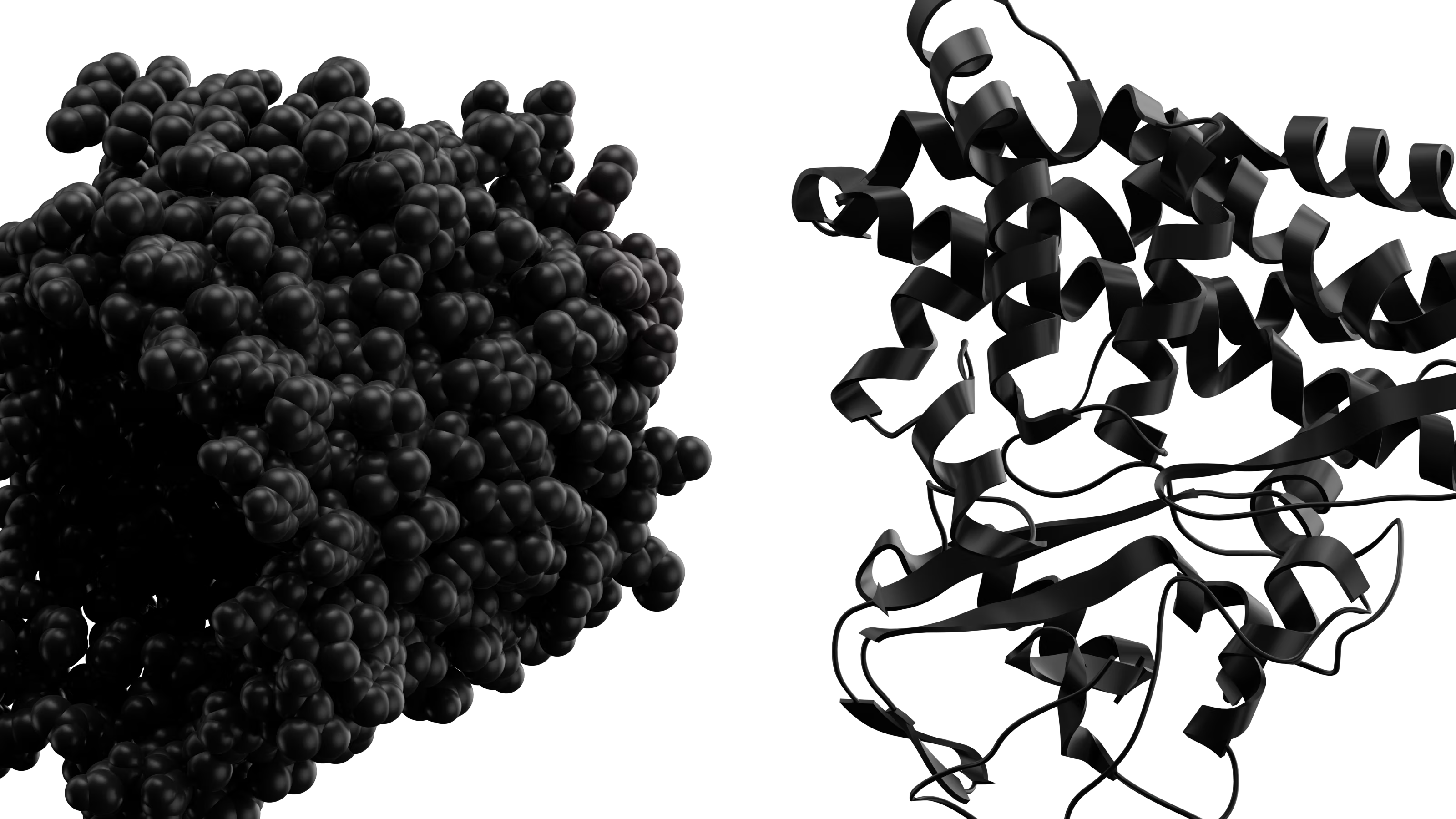
is a large number. Biologically impossible. And yet in a thought experiment known as Levinthal’s Paradox1, this is the number – 5.15 x 1047 – of ways in which even a small protein could fold. At a reasonable rate of random folding attempts, such a protein of 101 amino acids would take 1027 years before finding the single “correct” fold. That is, the fourteen billion-year history of the universe would have to repeat itself again, and again… and again, nearly 100 quadrillion times over, before our protein stumbled onto its correct fold.
The resolution of the paradox is that biomolecules do not fold blindly. They do not randomly try different shapes until they find the right one. They instead follow an energy landscape, a landscape with high mountains and at least one very deep valley. Like a ball rolling downhill, proteins are driven energetically to their “correct” fold. When guided by even modest thermodynamic nudges in the form of such a landscape, the folding problem collapses from impossible to shockingly routine on biological timescales. Indeed, a minuscule energy reward of 2kT per residue, or a fraction of the energy in a water molecule’s hydrogen bond, is enough to accelerate our hypothetical protein’s folding from 1027 years to less than a second.1
This is a core theme of not just protein folding, but of life itself: biological landscapes render infinity manageable.
Drug development wrangles with even larger combinatorial problems. It requires deriving from near-infinite sequences and structures a single molecule that achieves not just a fold, but numerous properties – solubility, stability, affinity, selectivity, and the list goes on. Thus far, peptide drugs in particular have been developed empirically, through trial-and-error campaigns which consume hundreds or even thousands of scientist-years. They rely on serendipity, like hunting, wherein deep know-how can improve chances but never eliminate the necessity of time and luck, and wherein failure remains the most likely outcome.
But what if we could illuminate the underlying landscape, the full set of relationships between sequence, structure, and drug properties? Then drug development shifts from a slow, low-probability hunt to a regular, predictable harvest. And our biochemical infinity collapses just like Levinthal’s – in this case, to the single best-in-class molecule for each drug program.
1 Zwanzig, R., Szabo, A. & Bagchi, B. Levinthal’s paradox. Proc. Natl. Acad. Sci. USA 89, 20–22 (1992). A protein 101 amino acids long has 100 bonds. If each bond could take one of 3 states, 3100 yields 5 x 1047. Note that the median protein in nature is ~300 amino acids.
Infinity multiplies
Peptides combine the best features of classical drug modalities – small molecules like statins and macromolecules such as antibodies – but require more optimization. Because they offer more as a drug, there is more to tune. Greater infinities to manage.
Specifically, small molecule compounds are, well, small enough to penetrate biological barriers and tissues, reaching intracellular targets and enabling oral (pill) formulations. They are typically straightforward to make. But their small surface area can limit potency and selectivity, often narrowing therapeutic windows and resulting in unpredictable toxicity issues. Most also clear within hours, requiring daily or more frequent dosing.
Meanwhile, antibodies have weeks-long lifetimes baked in to their biology, and achieve potency and selectivity through physically larger interaction surfaces. Yet their molecular size also precludes oral formulations or access to intracellular targets. Further, antibody manufacturing is extremely time- and resource-intensive.
Peptides are mesomolecules that can tune each of these features. They can be engineered for oral formulation as pills. They can access difficult targets inside cells or in the brain. Yet they have shown potencies and selectivities on par with antibodies. Their off-target toxicity is far lower than that of small molecules. Existing peptide drugs last a week; once-monthly versions are coming. And their synthesis is far more straightforward than manufacturing an antibody. An additional benefit to peptides as a drug class is that they can as easily agonize as antagonize a signaling pathway; classical drugs are predominantly inhibitors.2 As highlighted in our first post, the GLP-1s are illustrative examples: they are potent, selective agonists, last for a week, and can be dosed orally.
The challenge is that each of these features is also one more layer to manage on top of the near-infinite sequence-structure space, an additional dimension to map and optimize against the others.
2 We don’t include medicines such as mRNAs and gene therapy here as “classical” drugs.
Data draws the map
Let’s look back at the protein folding problem. AlphaFold learned the protein sequence-structure landscape by training on 200,000 experimentally determined structures from the Protein Data Bank, the accumulated output of five decades of structural biology. From those experimentally validated datapoints, the DeepMind team built a model that unlocked accurate folding prediction for nearly any protein. They showed that effectively infinite biochemical landscapes could be mapped and navigated computationally. When the Nobel Committee awarded the 2024 chemistry prize to AlphaFold’s creators, the opening page of the Committee’s report cited, appropriately, Cyrus Levinthal and his paradox.
Solving the peptide therapeutic problem, shifting from empirical search to predictable design, requires mapping numerous additional landscapes: those connecting peptide sequence to each of agonism/antagonism, affinity against multiple receptors, circulation half-life, subcutaneous and oral bioavailability, and others. Each feature is its own bio-cartographical undertaking requiring tens to hundreds of thousands of datapoints.
From hunt to harvest
When Brad and I started Ormoni, we committed to this vision – data at scale for every needed peptide drug property. The goal is not to search more broadly and thoroughly than ever before, but to map and computationally model the near-infinite landscapes underlying these properties. So we established unprecedented experimental capabilities, generating 6,000,000 datapoints in our first year, alongside computational capabilities to integrate the learned landscapes into multiparameter models. Once the landscapes are mapped, each drug program becomes a query rather than an expedition: specify the target product profile, and navigate the overlaid landscapes to the single molecule that best satisfies it.
For most of history, humanity hunted whatever the land happened to offer. The hunters’ skill was real but never scaled, and it never guaranteed dinner. Then, roughly 12,000 years ago, we learned how to cultivate the landscape, and to harvest it. Dinner became a plan rather than a contingency.
Drug discovery is still in its hunting age. Yet Levinthal’s protein never relied on serendipity, and neither should we. Mapping the multidimensional landscapes of drug properties, at scale, allows us to approach drug development as a harvest that yields better therapeutics, faster, for more patients.
Our next post examines an early landscape Ormoni has mapped at 100X previous throughput, and how the approach drove rapid predictive design of critical drug properties.